
Wilson County Parole Versus Probation
Parole and probation can both place a released Wilson County person under TDOC Community Supervision, but they begin in different ways. The Tennessee Board of Parole decides whether an eligible state prisoner receives parole before sentence expiration. A court orders probation, either in place of confinement or after a period of split confinement. Split confinement combines jail time with a term in the community. The Board does not grant probation, and a judge does not turn a probation order into parole.
The distinction determines which record explains the supervision. A Board action and TDOC release authorization document a parole path. A Wilson County judgment or probation order documents probation. FOIL, Tennessee's Felony Offender Information Lookup, is the public first check for either form of felony supervision. Its Supervision Status and Assigned Location fields help route the inquiry, but the originating order remains the stronger source for why supervision exists.
| Point | Parole | Probation |
|---|---|---|
| Who decides | Tennessee Board of Parole | Sentencing court |
| When it starts | Before a prison sentence expires, after required release steps | Under a court order, sometimes after split confinement |
| Who supervises | TDOC Community Supervision | TDOC Community Supervision for covered felony cases |
| Best public locator | FOIL status, location, and hearing fields | FOIL status plus the Wilson County probation order |
- Parole
- Conditional community release before a state sentence expires.
- Probation
- Court-ordered supervision in the community.
- Discharge
- The formal end of active custody or supervision within the named system.
- Absconder
- A person whom the supervising authority reports as no longer complying with required contact.
Check Wilson County Supervision Status
Begin with the custody system that released the person. FOIL covers people currently or formerly in TDOC custody or supervision, including felony parole and probation. It does not cover every misdemeanor-only Wilson County case. Search with a TOMIS or TDOC ID when available because a stable number is safer than a name match. For a name search, compare birth date, aliases, physical identifiers, SID, offense, and sentence data before accepting a result.
- Open the TDOC FOIL search and choose name, TDOC ID, or State ID/SID.
- Complete the case-sensitive CAPTCHA, then match the result with more than the name alone.
- Read Supervision Status for Parole, Probation, Incarcerated, or Inactive. Check Assigned Location at the same time.
- For parole, compare the Parole Hearing Date and Result with the current status. A grant is not the same as an actual release.
- For probation, obtain the Wilson County judgment or probation order because the court imposed that status.
- When a result points to District 81, contact the Wilson office to confirm the correct reporting jurisdiction.
A FOIL status of Inactive generally means no active TDOC custody or supervision. It does not settle every local, federal, or immigration matter. Likewise, Incarcerated at a new assigned location means the person transferred and did not enter the community. For the full county release and records path, use the Wilson County released-inmate search.
Wilson County District 81 Office
Wilson County has a named TDOC Community Supervision location. The field office directory places the Lebanon office in District 81, which also serves Robertson and Sumner counties. The district office is in Gallatin. Those layers can look inconsistent unless the FOIL Assigned Location is read with the local office listing. The Lebanon contact is the practical route for clarifying which office handles a Wilson reporting assignment.
TDOC District 81 Wilson
1432 West Main Street, Suite 500
Lebanon, TN 37087
Phone: 615-443-2759
Fax: 615-443-2856
The official TDOC field office directory is the source for this listing. No public office hours were verified in the research, so a caller should confirm access before traveling. Staff can help clarify jurisdiction and public routing, but confidential supervision details may not be released to a third party.
The directory image below comes from that same official TDOC source.
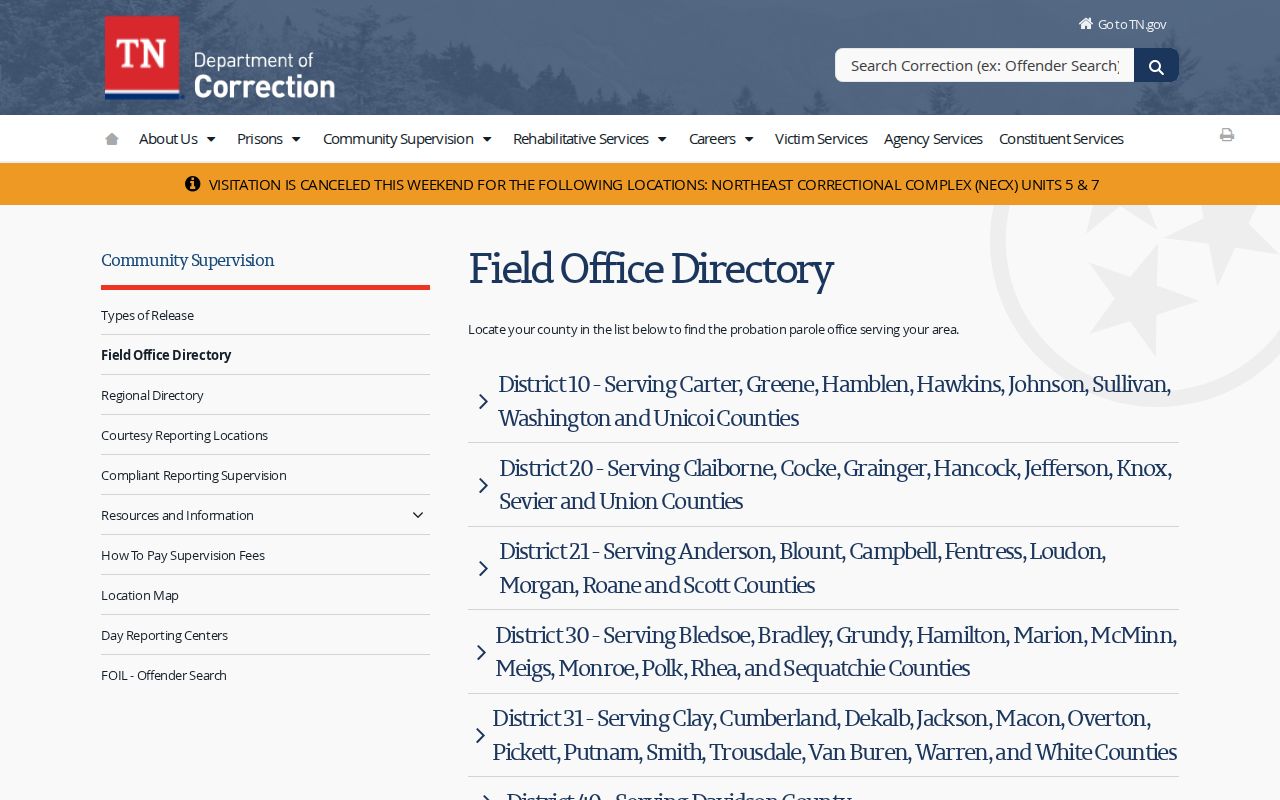
The directory image supports the Wilson office route. FOIL's live Assigned Location still controls which listed office should be contacted for a particular record.
Assigned Location is useful because a person may have a Wilson case while reporting through another office. A move, transfer, or case reassignment can change the office without ending supervision. Preserve the FOIL label and the date it was checked. Do not infer a violation from an unfamiliar location.
Note: District 81's multi-county structure makes the FOIL location and the Lebanon office listing important parts of the same check.
Wilson Supervision Violations and Warrants
Conditions are the rules a person must follow while under parole or probation. Their exact terms come from the Board action, release plan, judgment, and supervision instructions. A high-level record may show a supervision status, but it does not disclose every condition. Courts handle probation violations. The Board handles parole rescission or revocation decisions, while TDOC officers supervise compliance and report alleged violations through the proper process.
No official Wilson-specific public absconder list was found. A missed appointment, stale web result, or unsuccessful phone call is not enough to label someone an absconder or claim a warrant exists. A sex-offender registry may use an Absconder status, but that label applies only to the registry population and should not be generalized to all parolees or probationers. Suspected warrant status belongs with TDOC, the supervising court, or law enforcement.
Tennessee VINE can provide custody-event notifications from participating sources. It is not a statewide supervision-violation database. A VINE alert may concern release, transfer, or escape, and the agency named on the event sets its scope. Use it as a notice to verify the next custody step, not as proof that supervision started, ended, or was violated.
Wilson County Reentry Program Context
WCSO identifies Alcoholics Anonymous and weekly church or Bible study among programs at the jail. A July 2025 WCSO news report also described HiSET graduates and Moving Forward classes during the prior school year. These facts show what was offered in custody. They do not promise that a specific person attended, completed a program, or achieved a set result after release.
This local program context can help when reviewing a release plan or seeking accurate records of participation. The WCSO Corrections description and agency news are the proper sources. Post-release conditions and referrals still come from the court, Board, TDOC officer, or approved plan. A jail program and formal community supervision are separate records.
For parole, an approved release plan and required preconditions must be complete before the person leaves state custody. For probation, the court order controls. TDOC states that a person placed or released on probation must report within 48 hours. That rule should be read from the applicable order and agency instruction rather than treated as evidence of a person's compliance.
Other Tennessee release categories must also stay distinct. Determinate release applies only in defined felony-sentence circumstances and includes statutory notice steps. Mandatory reentry supervision may govern qualifying newer offenses. Neither term should be used as a substitute for parole or probation without the judgment, offense date, and controlling record. FOIL can route the inquiry, but it does not erase those legal differences.
Note: Program availability is local context, not proof of enrollment, completion, or a particular post-release outcome.
Wilson County Supervision Discharge
Supervision ends through an official discharge, sentence expiration, court action, or other authorized record, not by silence in a public search. FOIL may move to Inactive when there is no active TDOC custody or supervision. Because FOIL is a locator rather than the whole legal file, an important conclusion should be paired with the order or discharge record held by the responsible agency.
For probation, ask the Wilson clerk for the judgment, probation order, and any public satisfaction or termination entry. General Sessions and Circuit Criminal hold different parts of the local case path, so use the case number and division shown on the record. For parole, the Board action explains the decision, while TDOC's release and supervision records establish the actual custody and discharge steps.
No separate official statewide public parole-decisions database was verified. FOIL can display an individual Parole Hearing Result, but the underlying decision or action sheet must be requested from the Tennessee Board of Parole records route. A hearing result and a completed gate release remain different events, so confirm the latter through TDOC status and the release record.
A no-result has limits. Name spelling, aliases, feed timing, an old record, or another agency can all account for it. Preserve stable identifiers such as TOMIS/TDOC ID or court docket number, along with the source and check date. This avoids turning a gap in one system into a claim that all legal supervision has ended.
Tennessee public-record law permits requests for identifiable existing records, subject to exemptions and agency rules. Ask for a specific Board action, probation order, termination entry, or TDOC discharge record. An office does not have to create a supervision conclusion that is not already recorded. If copies carry a cost, request an estimate first and ask whether an electronic copy is maintained.