
Wilson County VINE Coverage
Tennessee VINE, also called TN SAVIN, is a free and confidential custody-notification service. The Wilson County Sheriff's Office links directly to a Wilson-specific VINE search using Tennessee site ID 43000. That local route supports the conclusion that Wilson County Jail custody events feed the service. The Tennessee Department of Correction VINE announcement covers state offenders. Always read the source agency on the result because the county and state layers describe different custody.
A WCSO event may concern booking, transfer, or release from Wilson County Jail. A TDOC event concerns state custody or supervision. Neither source covers every possible federal or immigration event. VINE can report a release, transfer, or escape, but those words are not interchangeable. A release from one custodian may be a handoff to another. The destination and agency are part of the fact.
The official VINELink search shows the Tennessee entry point used for a person-specific check.
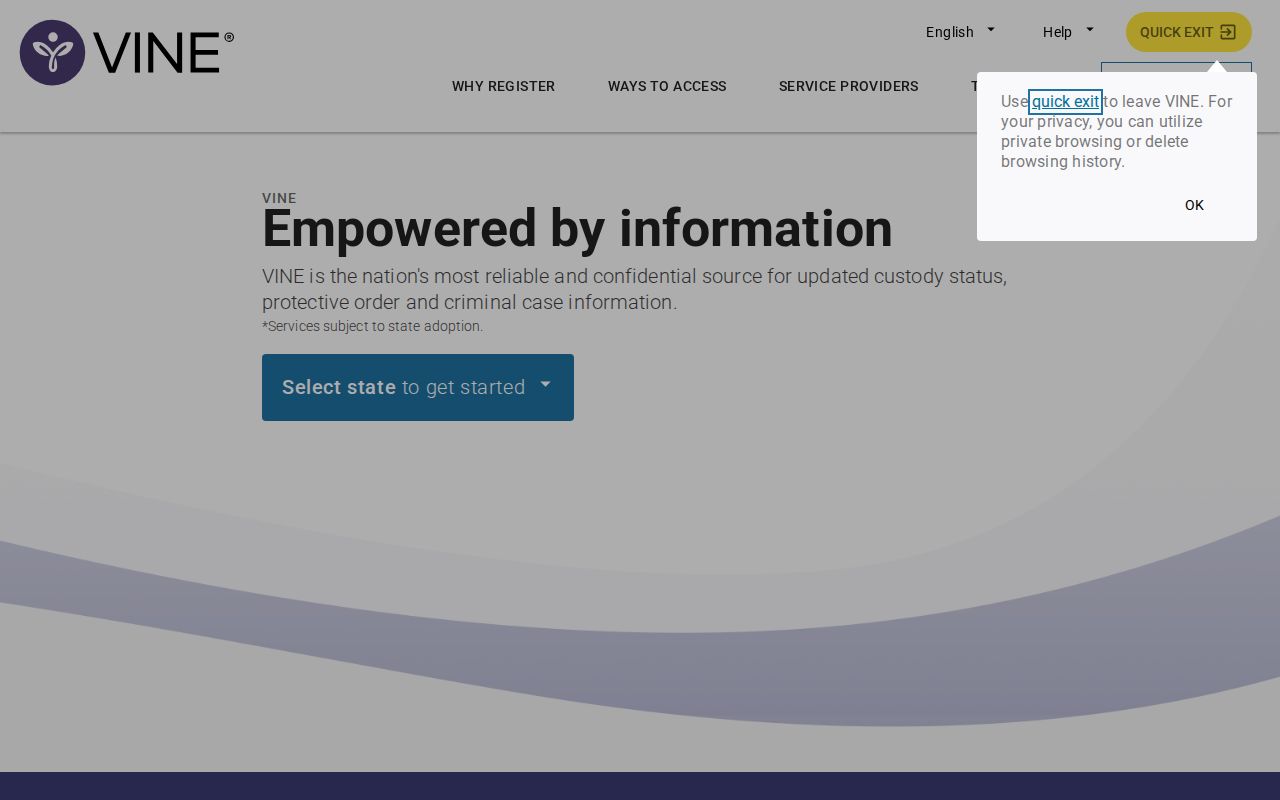
Wilson County users should move from that state entry point to the correctly matched agency record, then preserve the event label before registering an alert. A screen that proves access to Tennessee VINE does not, by itself, prove any named person's custody or release.
Search a Wilson County Inmate
Start with the exact identity, not a guess based on name alone. An offender or booking ID is the best match when it is known. Names may collide, and aliases or suffixes can alter the result set. The agency shown on the record must also fit the custody being checked. For a broader county search path before setting an alert, use the Wilson County released-inmate search and records coverage.
- Open VINELink or call its support line, then choose Tennessee and the offender or custody search.
- Enter the exact name or offender or booking ID. Try a known alternate spelling only when the first search fails.
- Compare the agency, identifier, and displayed identity details. Do not select a record solely because the name looks right.
- Open the record and read the custody status, source agency, and event label together.
- If the result says released, check whether it names a transfer or another custodian before treating it as community release.
- Confirm a material result with WCSO, TDOC, or the court record that controls that part of the event.
For Wilson County Jail, a recent release can also be checked in the WCSO Released-name search. For a felony offender, FOIL may identify a current or former TDOC status. These checks are not duplicates. They help distinguish a Wilson County jail exit from a state-prison discharge.
Wilson County VINE Release Fields
The exact fields depend on the participating source and the record that is open. Treat each label as bounded to that agency. VINE is an alert and status index, not the judgment, dismissal, or full release sheet. The core fields used to test a match are summarized below.
| Field | What it establishes |
|---|---|
| Name and identifier | Links the result to a specific person when checked against reliable identity details. |
| Source agency | Shows whether the event comes from Wilson County custody, TDOC, or another participating agency. |
| Custody status | Reports the status supplied by that agency, subject to feed timing and later correction. |
| Facility or location | Helps identify the custodian or the next place to contact after a transfer. |
| Event type | Distinguishes release, transfer, escape, or another reported custody change. |
| Notification eligibility | Shows whether a contact method can be registered for that record. |
A released label does not state the final court outcome. It also does not prove that all custody ended. If the source is WCSO and FOIL later shows incarceration, the county event may have been a transfer into state custody. Court documents answer what authorized the change, while the custody agency records what it carried out.
Register Wilson County Release Alerts
Registration is confidential, and the service says the offender is not told who registered. Phone, text, email, or TTY may be available. More than one contact can be registered. Use a direct number rather than a switchboard so the intended person can receive and acknowledge the notice.
- Open the correctly matched Wilson County or TDOC record while notification registration is available.
- Select the registration option and choose phone, text, email, or TTY.
- Enter the requested contact details. Register more than one reliable contact when appropriate.
- For phone calls, create and retain a private four-digit PIN. Email registration does not use that PIN.
- When an automated call arrives, enter the PIN to acknowledge it. Calls may repeat until acknowledged or for up to 24 hours.
- After an alert, verify the event with the named jail or corrections agency.
VINELink operators are available at 888-868-4631 around the clock. TTY support is 866-847-1298. If a phone PIN is forgotten, call and press 0 for operator help or reset. The alert is useful notice, but it does not replace direct safety planning or agency confirmation.
Wilson County VINE Limits
A no-result is inconclusive. The cause may be a spelling issue, alias, wrong state, wrong agency, restricted or old data, feed delay, transfer, or a source that does not participate. VINE is not the Federal Bureau of Prisons locator or the ICE detainee locator. It also is not a complete court-record system. Each gap has a different fallback.
For federal custody, use the BOP Locator for a sentenced or designated prisoner. A federal pretrial person may require the Middle District of Tennessee docket or a U.S. Marshals Service record. For immigration custody, ICE has its own locator and a limited post-release window. Silence in one system cannot establish release from another.
Note: A VINE event reports source-agency data and may lag; it is not a court disposition or a promise that no hold exists.
Wilson County SAVIN Handoffs
Wilson County has an unusual two-layer notification path. WCSO places an Inmate Release Notifications block on its own site and sends the user to Tennessee VINE with the Wilson site ID. TDOC separately feeds state-offender events into VINE. The visible agency name tells the reader which layer produced the notice.
This distinction becomes critical during a detainer release. TDOC's release-notice form directs readers to SAVIN when a state release occurs by detainer to a Tennessee county. In plain terms, TDOC custody may end while county custody begins. A notification can therefore be accurate even though the person did not enter the community. Read the destination and then contact that receiving agency.
The same reasoning applies when WCSO records a release to TDOC. The Wilson County event documents an exit from the jail, while FOIL may show incarceration at a state location. The two records describe consecutive parts of one custody path. Neither should be forced into a single, vague claim that the person was simply released.
TN SAVIN's phone process adds another local detail. Automated calls repeat until the registered PIN acknowledges the notice or for up to 24 hours. Email registration has no PIN. A recipient who misses a call should not infer that no event occurred, and a person who receives one should preserve the event wording and source agency before calling the custodian. That wording may be the clue that separates release to the community from a transfer.
Verify Wilson County Release Status
Verification gets stronger as it moves from an automated notice to the official agency detail and then to the underlying release sheet or authorization. For WCSO, compare the VINE event with the 24-hour or 72-hour Intake/Release view, the Released checkbox name search, and direct jail confirmation. For TDOC, read FOIL's Supervision Status and Assigned Location, then request the Release Authorization when the actual Date of Release and Released To fields matter.
- Release
- An end to custody by one named agency, which may still lead to another custodian.
- Transfer
- A move between facilities or agencies while custody continues.
- Discharge
- An end to the relevant correctional custody or supervision, subject to the record's exact scope.
- Detainer
- A request or hold that may cause one agency to hand a person to another.
Identity deserves the same care as status. Match a booking number, TOMIS or TDOC ID, or another stable identifier when possible. A name and photograph can help, but both can mislead. A stale image does not prove present status, and a common name does not prove that a notice belongs to the person being checked.
WCSO's 24-hour and 72-hour Intake/Release pages answer whether an event appeared in a short rolling window. The separate Released checkbox search reaches beyond those windows, though its online retention is not published. When VINE and WCSO differ, compare timestamps and event types. A current roster may update before an alert, or an alert may identify a transfer that the short feed does not explain in full.
FOIL provides the state comparison. “Parole” or “Probation” shows community supervision, “Incarcerated” with an assigned location shows continuing state custody, and “Inactive” means no active TDOC custody or supervision. Inactive should still be checked against release information or an archived release record. FOIL's Release Eligibility Date is prospective and must not be converted into a VINE release date.
A court result belongs in the final check when the legal basis matters. Wilson General Sessions records may contain a bond or release order, while Circuit Criminal may hold the final judgment for an indicted felony. The court can establish what was ordered. WCSO or TDOC establishes what custody event was completed. VINE helps connect the timing, but cannot merge those records into a new legal conclusion.
Keep a note of the time, source agency, identifier, and exact event wording when confirmation is important. Those four details let WCSO or TDOC staff identify the right custody episode. They also help explain later differences caused by feed timing without treating the first screen as false or the later screen as proof that every prior event was wrong.